On being honest and resting in God
"Hate what is wrong. Hold tightly to what is good." Romans 12:9
Here is what Jim Naughton wrote today on the Episcopal Cafe:
Here are some important resources:One argument that gets made against the Episcopal Church's efforts to fully include lesbian, gay, bisexual and transgendered Christians in the life of our church is that this initiative entails compromising the vaules of the Gospel with the values of permissive Western culture. Another argument sometimes offered is that our efforts at inclusion matter place the interests of a privileged class of western activists ahead of those of the church in the developing world.
There is, at the heart of both of these arguments, a willingness to ignore the fact that our purportedly permissive culture is in many cases quite hostile to LGBT people, that this hostility in some instances has lethal consequences, and that church leaders both here and in the developing world often fan the flames of this hostility.
In the wake of the bullying-related suicides of recent weeks, it is time for Episcopalians to make it clear that they are not surrendering to the prevailing culture, but attempting to transform it through the love of Jesus Christ. We are small in numbers, and our example may not posses the power we would like, still--if judged by the expensive ferocity of the resistance it has encountered--it counts for something.
We have, on occasion, compromised the authenticity of our voice, by seeking to placate those who have argued either that we were moving too far, too fast, or that we were heading entirely in the wrong direction. But we did not move fast enough to save any of the lives of the young people who killed themselves in recent weeks, and there is no moral equation in which tranquil relations within our own church multiplied by the good opinion of the leaders in other parts of the Anglican Communion counts for more than the lives of bullyed children.
http://community.pflag.org/Page.aspx?pid=566
Believe Out Loud:
http://bolec.integrityusa.org/
http://believeoutloud.com/
Reunion
 Updated: Monday, August 16, 2010
When I share my faith story I sometimes give it a title:
Besides trying to evoke a few chuckles by conjuring the image of a young Michael Landon as a Bible carrying werewolf, it refers to being a part of a group of young people in the first half of the 1970s who had a deep impact on my life.
A few weeks ago, this group had a reunion. Imagine that. A youth group reunion. What drew us together again taught me a lot about Christian community and how we friends and apprentices of Jesus are a living Gospel story.
It all started when my family moved to a new town in the middle of the school year. I arrived in a new Junior High in December, 1970 and for a few long months had a hard time getting used to the place. Then one day before school, two people from my home room invited me to come with them and to “see something.” What? I asked. You’ll see, they said. These kids were friendly to me and went some distance to make me feel at home, but I can’t say I really knew them yet. What they invited me to was a before-school prayer meeting in a far corner of the empty cafeteria.
I was invited to Bible study in the home of some older high school kids (some of whom included The Coolest Guys in their classes) and where we sang songs, studied the Bible and prayed. We’d go on hikes, picnics and to the beach, go bowling and hang-out. Our group ran two—yes, two—Christian coffee houses, the first in a tough neighborhood in the city and another in our own town.
It was not all church all the time. We also took part in all the normal high school rituals of sports, social life and clubs—and in this context we worked out all the same questions of identify, belonging, sexuality, relationships, and sense of self that all adolescents must negotiate. Here I must stop and tip my hat to my parents, God rest their souls, who endured having a teen-aged son who chose to work out his adolescent rebellion by becoming a Jesus Freak.
Early on, a new, young pastor and his wife came to a tiny Baptist Church in town and adopted this little group, which eventually grew to over three dozen—sometimes more-- kids crammed into their living room every Tuesday night.
This group was and remains the foundation of my Christian story. To the extent that my preaching, pastoral care and way of thinking about Christianity affects how I go about my ministry today, this group of high school aged Christians has had an effect on everyone I've ministered with since.
So it was with some anticipation and, yes, even a little dread, that I returned to Connecticut and took part in a reunion of this group of people who so much a part of my life in high school—and my walk with Christ. I wondered how a big-tent, progressive Episcopalian would fit in. I wondered if the group would feel safe to those who have left the fold. I wondered if our diversity of experience would trump our common origin, or if God’s Spirit would draw us together again in a new version of an old community. Of course, not all of us were there, but those who were able to make it represented a healthy cross-section of the original group spanning several years.
The Good News: God’s Spirit swept away all anxiety. What was old was made new. Imagine that!
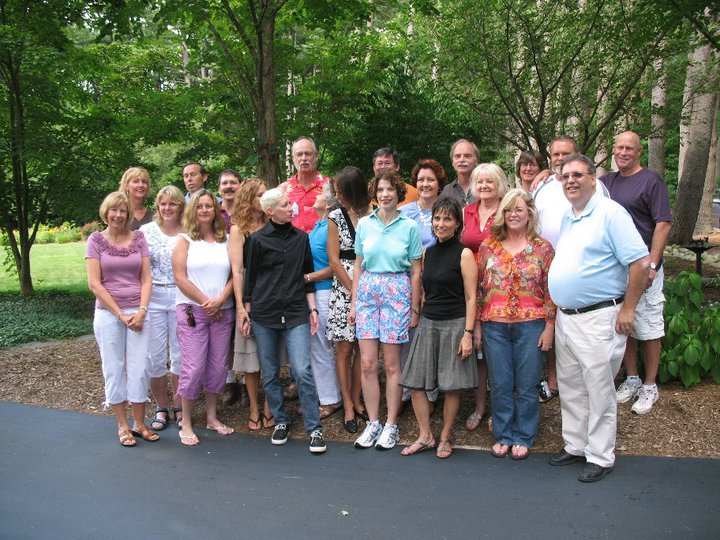 What was amazing was how many different directions we had taken. Some of us have gone through some very stormy times. I heard many story of many challenges in many lives: childbirth outside of marriage, divorces, the death of a spouse, changes in careers...a few of us have been kind of beat up by life. A few people brought their kids, who looked on this whole exercise with patient bemusement and open curiosity. Some came with their spouses and partners and everyone brought their stories. In short, we represented all the things one expect of a cross-section of people your basic American suburban high school after 35-plus years apart except for that one unique connection that usually does not show up at a typical reunion. Our time shared in Christian community.
In terms of everyone’s spiritual life there has been just as much variety of experience. Some folks are still part of that same Baptist Church—heck, that young pastor is still there forty years after he arrived fresh out of seminary!—others have joined churches very similar to it but in other places. Some of us have slightly tweaked their stance in a variety of Christian traditions. One person shared with me their connection to a breakaway Anglican church, whose preaching reminds her of home but whose liturgy is a rich, new experience. Some don’t go to church at all, but came back anyway and later talked of how refreshed and renewed they felt just the same.
Two weeks later I am still thinking about our reunion and what it meant to re-connect with these folks after so many years apart. One thing I’ve asked myself is, besides mere nostalgia, was there anything that can be learned from this group that can still inform the Christian walk of a 50-something Episcopal priest and his congregation, friends and family?
I know I am not alone in the kind of experience I had. Once, not long ago, I was visiting a parishioner in the hospital. As I was talking to her daughter, I mentioned that I was going from the hospital to meet with the youth group at the bowling alley. This brought a flood of stories of her own time in our youth group when she was young. She recalled the people, the fun…and the encounters with God in the middle of all that.
In my parish, we recently completed a building project that has expanded our parish house and made the church fully accessible. As we have re-opened the hall and started using the new addition, one thing I’ve also noticed is the way in which our own stories have played out in new ways. One long-time member of the parish just glowed when she said, not about the building but about the community, “I just love this church!” Another one of us was able, because of the new ramp, to enter the hall for the first time in decades. She told us the story of when she was last here, and from there it became a story of how her love for Jesus has grown through many, often difficult years. These moments are blessings that remind us that God is at work now.
Our faith-stories aren’t just dusty old scrapbooks of spiritual nostalgia but the keys to knowing how God is at work in and around us today. The real challenge is, having strolled down this spiritual memory lane, what do we do with it. How might this feed us now?
Getting in touch with our own Gospel-story reminds what it was that made us Christian in the first place. Touching again the time when our faith was new can recall for us how much God has done for us, and while we might smile at our youthful idealism, we will also discover how God’s Spirit transformed at key moments in our living.
Recalling our Gospel-story helps us interpret where we’ve been and gives us hints as to where we are going—both what we want to continue and what we seek to change. Instead of just being a phase or a distant past, we can begin to see the times when we have walked near to God and far from God both in terms of our own choices and responses to circumstances, but also see in new, perhaps unimagined ways, how God has walked with us in all we’ve done.
Perhaps the most important way we can make use of our story is to say it out loud. Hearing ourselves tell the story of our walk with Christ, hearing the words we use, the images we have, and even hearing the gaps in the story will do two things: it will feed and encourage others who are On The Way, and it will help us learn, reflect and deepen our faith. We may find that what we thought was a dormant or routine spiritual life is in fact The Holy Spirit going before us, doing remarkable things, preparing the way for something new.
Afterwards, one of the people at the reunion commented on Facebook that our gathering was like “a little piece of heaven.” She’s right. I see our time together as an illustration of what it means to be in communion. I suspect that if we filled out questionnaires or answered a survey, we’d find that our theological positions on many things have changed over the years. Some have locked down, some have become more flexible, but we have all adapted that first encounter with Jesus and Christian community to wherever we find ourselves today. Some of us are still quite active in churches (even the same church) and others have left religion altogether. We’d look around the group and say on the one hand “You haven’t changed a bit” and on the other “My! How you’ve grown!”
Still we gathered, we sang, we prayed. This is communion: that despite our variety of changes, perspectives and beliefs, we gather around the same Christ—who promised both to be with us always and to be present even in the smallest gathering—we listen and we dare to pray.
Seeing the face of Christ everyday
 Sister Patricia-Michael is a vowed solitary in the Diocese of Bethlehem, a spiritual director and the parish administrator in my parish, Trinity Episcopal Church in Easton, PA.
She has been inspired to start a blog that focuses on the theme of seeing the face of Christ in ordinary people in everyday places. It is called "When did I see you?", which she describes as "the daily intention of seeking and finding Christ in all things, in all places and in all ways." This is an outward expression of part of Patty's rule.
This is a discipline that is close to my heart and I invite you to follow her blog here.
Ninjapalians around one table
 Updated with Version 2.0. Some folks in the Episcopal Church took a couple of years to quantify and describe what many everyday Episcopalians already knew: that much more unites us than divides us.
Episcope described the findings:
- “Episcopalians passionately want their church to hold Christ as central and believe their church attempts to do so.
- “Episcopalians see the Church both actually and ideally as a people of the book whose faith is united by and expressed in their Book of Common Prayer.
- “Episcopalians view their Church as both aspiring to hold and successfully expressing a sacramental understanding of the Christian life and relationship with God.
- “Episcopalians view the church as committed to sacramental and incarnational understanding.
- “The Episcopal Church gathers around the Book of Common Prayer as one of its core unifying features and most profound expressions of faith.
- “Episcopalians see their Church as holding multiple theological perspectives, both locally and broadly, and have a deep appreciation for this aspect of Episcopal life.
- “Episcopalians would very much like to de-emphasis any notion of their church as elite.”
“Even among those who most strongly disagree with one another, there is some deeply held common agreement about core themes that are most central to Episcopal identity – holding Christ as central, ordering around the Book of Common Prayer and a sacramental life of faith, emphasizing scripture, holding incarnational theology as important, and being pastoral in response to life’s challenges,” observed Gortner. “The findings also provide some exciting opportunities for deeper discussion about how Episcopalians choose to live and express what is most central, enduring, and distinctive about their shared Christian life and faith.”A video was created to tell us the results of the study and to remind us what we all share. It is very slick and well-produced. I don't know how long it took them to make. Here it is.
Over the period of a week or so, some folks at King of Peace Episcopal Church, Kingsland, Georgia put this video together. Starting this morning, when it appeared on YouTube and then Facebook, it has now appeared on many blogs and web-sites. Here it is:
So, which one better describes the findings of the study? I vote for the Ninjas.
The "gay agenda" observed
 Yesterday, folks from several Lehigh Valley Episcopal Churches staffed a booth at the Pride in the Park festival, the largest gay pride event in Northeast Pennsylvania, including some members of my own parish. I observed a few things which sharing: one is old news that bears repeating and the other indicative of a healthy trend.
But first, here is what the Rev. Scott Allen (at left in the picture), priest in charge at St. Andrew's, Bethlehem who once again organized this years effort, wrote to all of us in a thank you note:
Thank YouSix Episcopal congregations from the Lehigh Valley took part. From my own parish, five people volunteers and several others came by and said "hi". This was very heartwarming to me.To all the stalwart, faithful and courageous soulsWho to Cedar Beach Park on a Sunday did goTo lend support, a smile and careTo our LGBT sisters and brothers gathered thereWhile the weather was HOT you performed with grace.Shaking hands and connecting with every face.From Mickey who gave the shelterAnd with the help of Ken and Jeff, helped us not to swelterTo Michael's graphic creativityYou witnessed with power to inclusivityMediator, Andrew, Anne and NativityGrace and two who bear the Holy TrinityGave witness and with your bodies and made true"The Episcopal Church Welcomes You!"Thanks for all your help, words, sweat, dog biscuits, flyers, dog sitting, sun standing, holy cards, banner holding, tape cutting, welcome giving, flyer passing and incarnate love for Jesus this year at Pride In The Park 2009! I am always humbled by your commitment.
This leads to my first observation, the one that gives me great hope: The Episcopal presence was not the only Christian or even the only religious presence at Pride in the Park. Congregations from the NE PA Synod of the Evangelical Lutheran Church in America was present. I don't know how many, but I did see that our neighbor from Downtown Easton, St. John's Lutheran, was present in a big way. The United Church of Christ was also present in a big way, as well as the Unitarian Universalist Church. Roman Catholics were represented by the Dignity booth (although the local chapter meets in an Episcopal Church). I had a very nice talk with a Mennonite pastor, an MCC pastor and her spouse, and a Baptist minister and his wife. I noticed that a Jewish group was present, too.
Which means that there were many more faithful Christians and people of other faiths present and engaged inside the gates than the handful of mean-spirited and angry religious protesters just outside the gates. I counted about a half-dozen protesters who said some angry, insulting and obnoxious things to me and others in God's name. The group called Silent Witness accompanied people up to the entrance with their rainbow colored golf umbrellas to offer a moving safe space from hate. A ministry of the Metropolitan Community Church in the Lehigh Valley, I realized that there were also many more Silent Witnesses than protesters.
The variety and quality of the religious presence tells me that religious community is being less and less fearful and allergic to being seen with and ministering among GLBT folks. We still have a long, long way to go but the strong positive religious (and Christian) witness on the inside has grown to the point where it has begun to balance if not overshadow the angry, the hateful and the nuts.
A related observation is how profoundly welcome I felt. The members of our parish who have taken part this year and in the past have said the same thing. Not once did anyone chew us out or shun us for the awful treatment gay folk have experienced at the hands of Christians and the Church. More often than not we were thanked for being present.
My other observation is not a new one. In fact, it is a statement of the hugely obvious but it is still worth repeating. It is a lesson that the straight folks in my parish who have little contact with the gay community needed to experience first hand.
I realized as I walked up and down the festival and talked to and stopped by vendors, exhibitors and activities, that I was walking in a living expression of the dreaded "gay agenda" that others have warned me about. If the vendors there were indicative of the "gay agenda" then it consists of things like vinyl siding, heating and plumbing, banking, real estate, pet grooming, life insurance, cars and car repair, recreation and resorts, restaurants and banquet facilities, health care, local politics, and on and on. The so-called "gay agenda" consists of all the everyday stuff of everyday living. Religion included.
Pride in the Park reminded me once again that the "gay agenda" is really rather simple and in no way sinister: to live everyday life, peaceably and with dignity as the person you are with the person you love without someone getting in your face.